Research Intern @Rutgers WINLAB
For the summer of 2026, I was a volunteer research intern at the Rutgers Wireless Information Network Laboratory (WINLAB). I worked with two other students under Dr. Richard Martin for the Green Communications project. I primarily worked on the hardware.
The Big Picture
The problems the project recognizes are that:
- Current wide area networks (WAN) are expensive and gatekept by governmental regulations and large corporations.
- Cellular networks tend to not cover rural areas, leaving individuals in those areas without access to the network.
- Those in war zones or under oppressive governments tend to face censorship
This reveals the need for a decentralized, accessible network.
The goals this project set to address that need are:
- Accessibility. The solution should scale down to underserved areas and should be cheap to deploy.
- Self-sufficiency via solar. The solution should not rely on existing infrastructure. Solar, hence “Green” Communications.
We anticipate on building a solar tree made of PVC pipes and solar cells, which will charge a battery and power a LoRa radio, forming one node within the greater MeshCore network. The idea is to send texts using radio instead of cellular networks. In addition to the tree, a camera is to be placed onto the tree to receive status updates, such as if a person or animal is present. This will be accomplished by using a local vision language model (VLM) on a Raspberry Pi.
There are solar-powered repeater radios on the market for MeshCore, but we would like to propose a solution to snow and strong winds and have it be self-monitoring by providing the user with status updates.
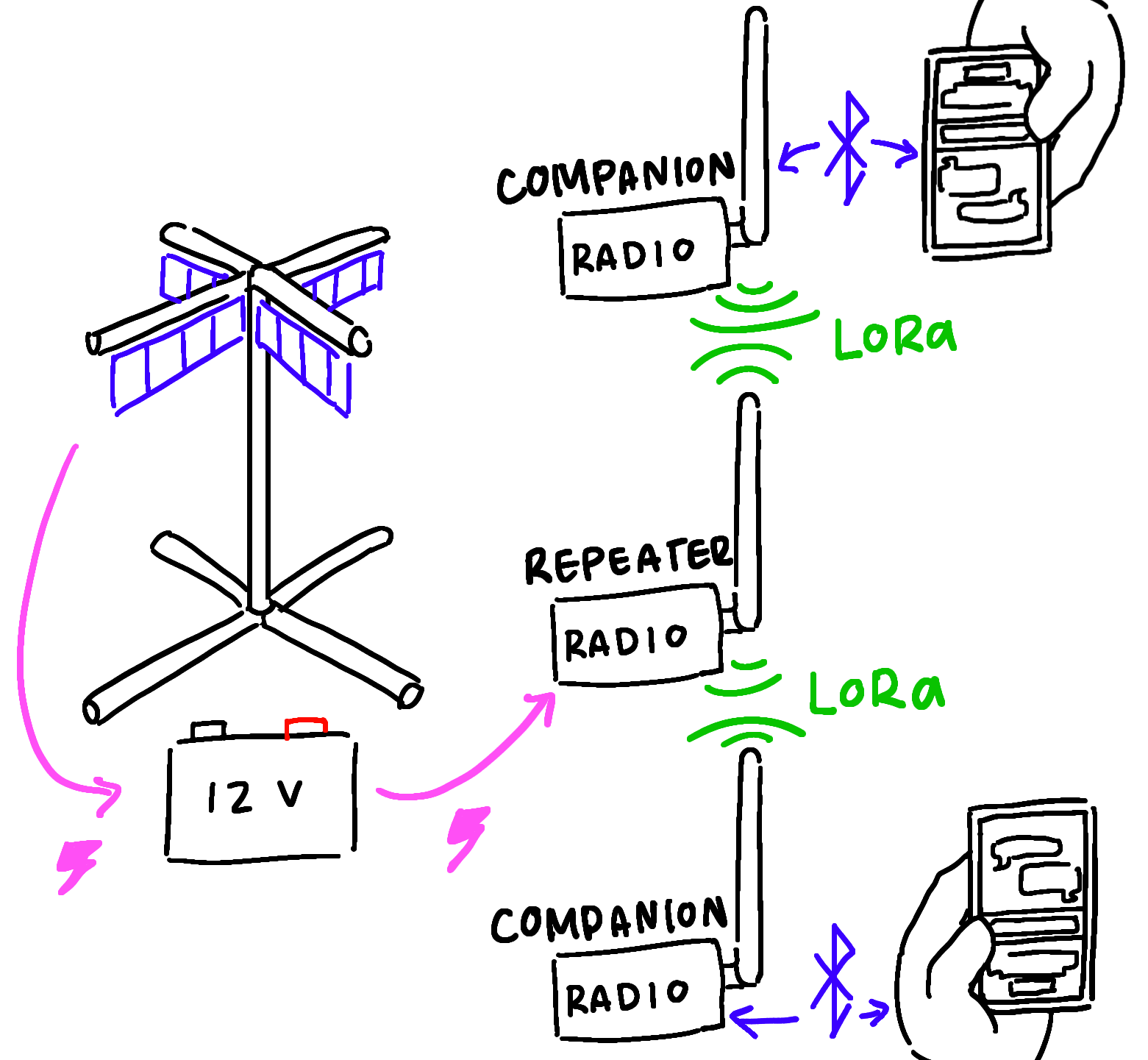
^ This is the big idea. Your phone pairs to a companion radio through bluetooth or wifi. Your text will be transmitted through the companion radio to reach your recipient via LoRa.
The Implementation
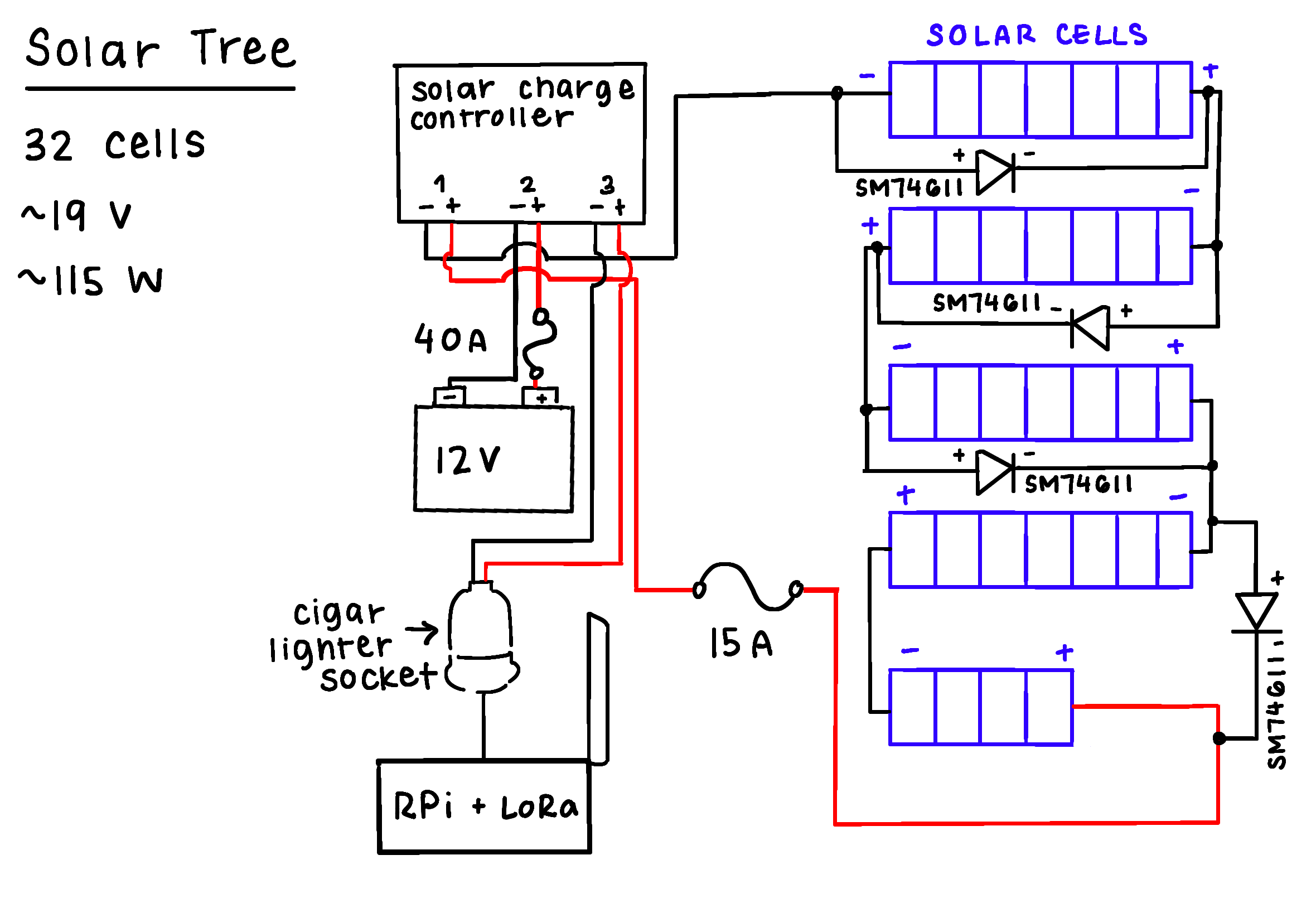
^ The wiring diagram. If you watch the video of our presentation given during the Open House, I made an update to this wiring diagram. The radio is a load on the solar charge controller.
The solar tree consists of 32 solar cells that total to about 19 V and 115 W. It would take approximately 3-4 hours of peak sunlight to fully charge the battery. To assemble the solar panels together, 5200 marine sealant was used to sandwich the solar cells between two sheets of clear acrylic to keep water out. Paper clips were also epoxied onto the back of the solar panels, allowing us to use zip ties to chain the solar panels to the branch. In case of strong winds, this allows the solar panels to swing. The vertical alignment of the solar panels also allows snow to fall through instead of build up on top of the panel.
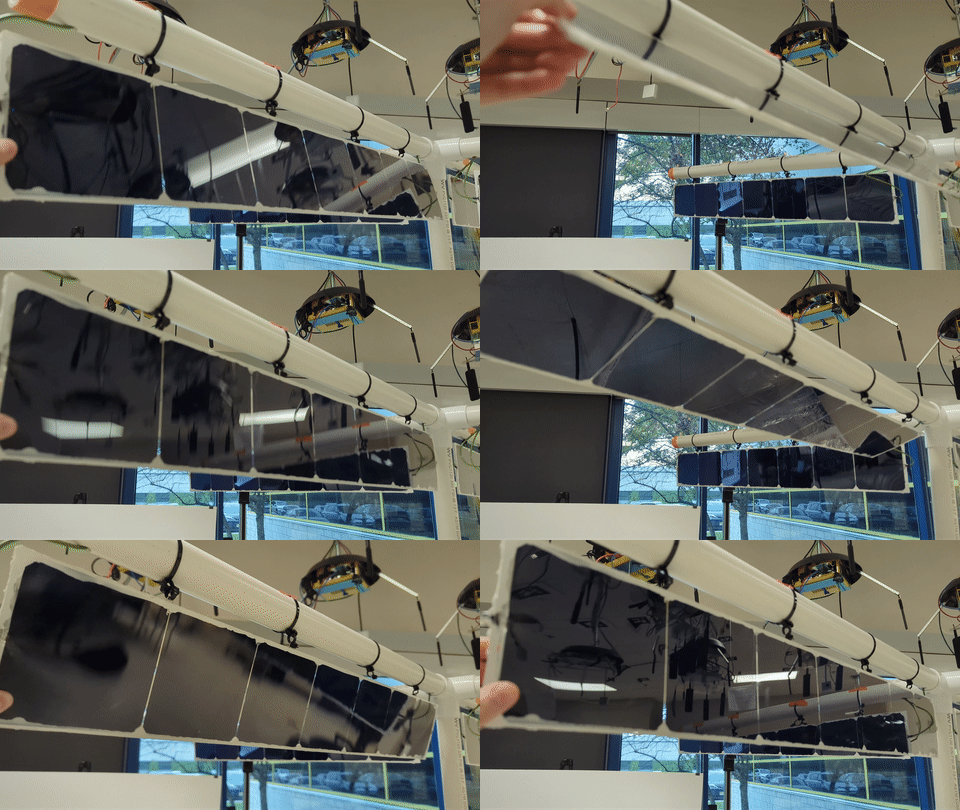
^ The branch swings.
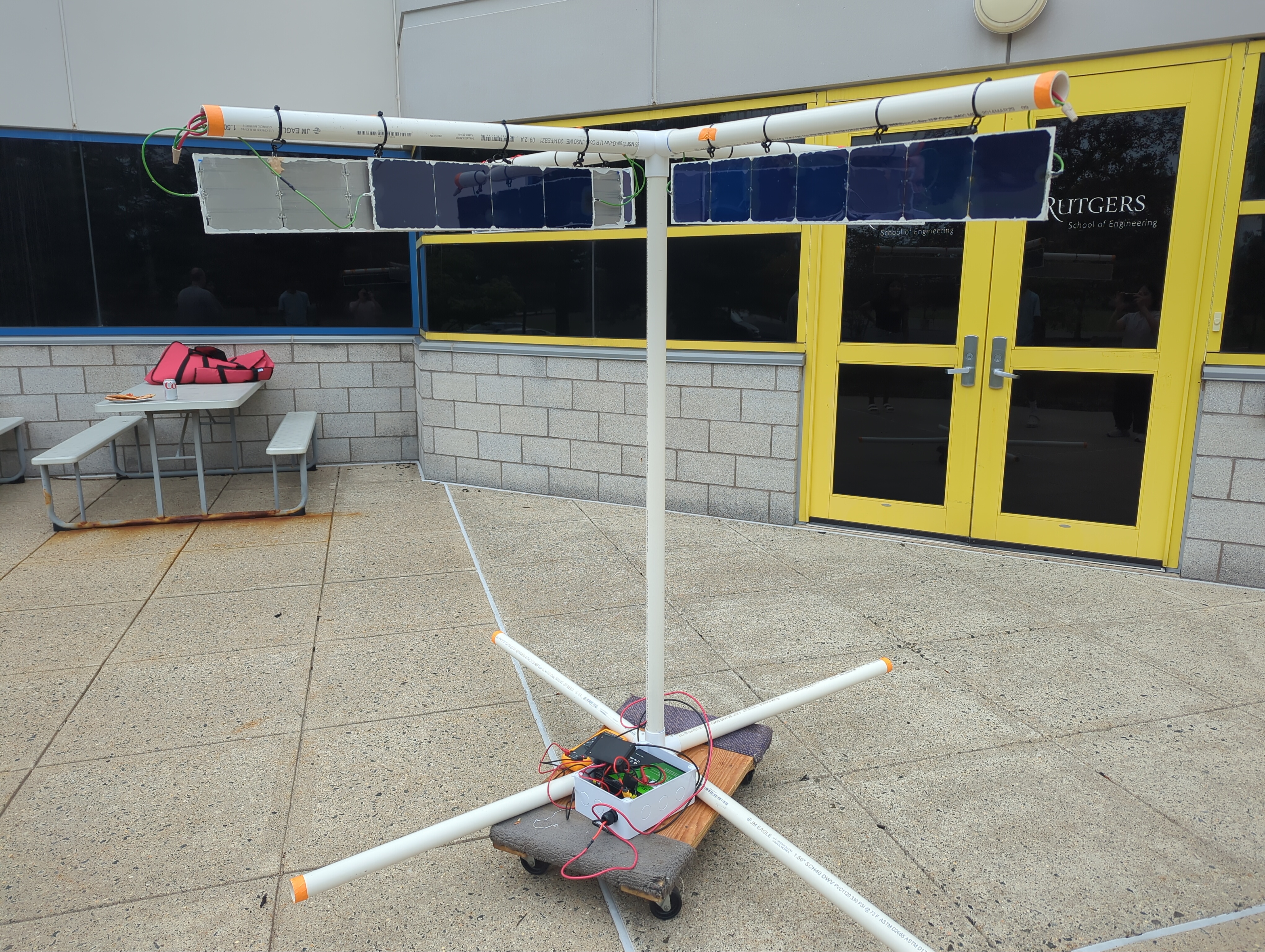
^ The assembled solar tree.
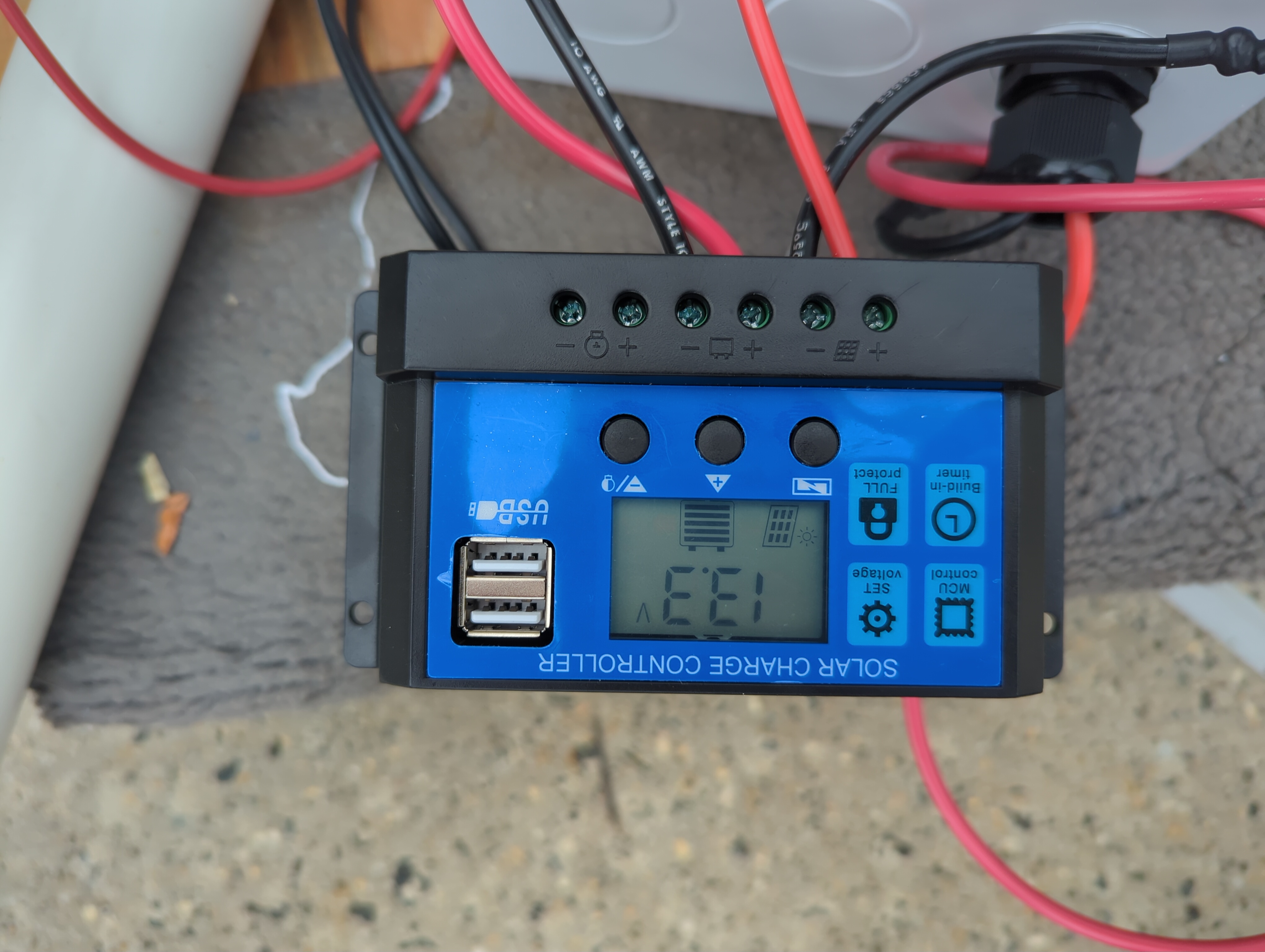
^ It’s charging! The weather was cloudy on this day.
Before receiving our boards, we were going to use a Raspberry Pi and an older SX127x transceiver. MeshCore was meant to be firmware flashed onto a microcontroller. We found that someone implemented MeshCore in Python, so I tweaked it to support the SX127x models.
More information on the VLM and camera atop the solar tree to come soon.
Mounting the camera and then deploying the tree to see if it can withstand the weather is the next step. We presented our project at the Open House on August 6th. Watch our presentation! (I think I went a bit too fast and I really needed to take breath towards the end of my bit… so if you notice I sound shaky, that’s why.)